Mac · iPhone · Apple Watch

Plan the hours.
See what they earn.

Tasks get real hours on the grid. Projects know their budget and whether the deadline holds. Clients, deals and revenue sit in the same app, so you stop copying between four of them.

7 days of every feature, then monthly or yearly · See what it does

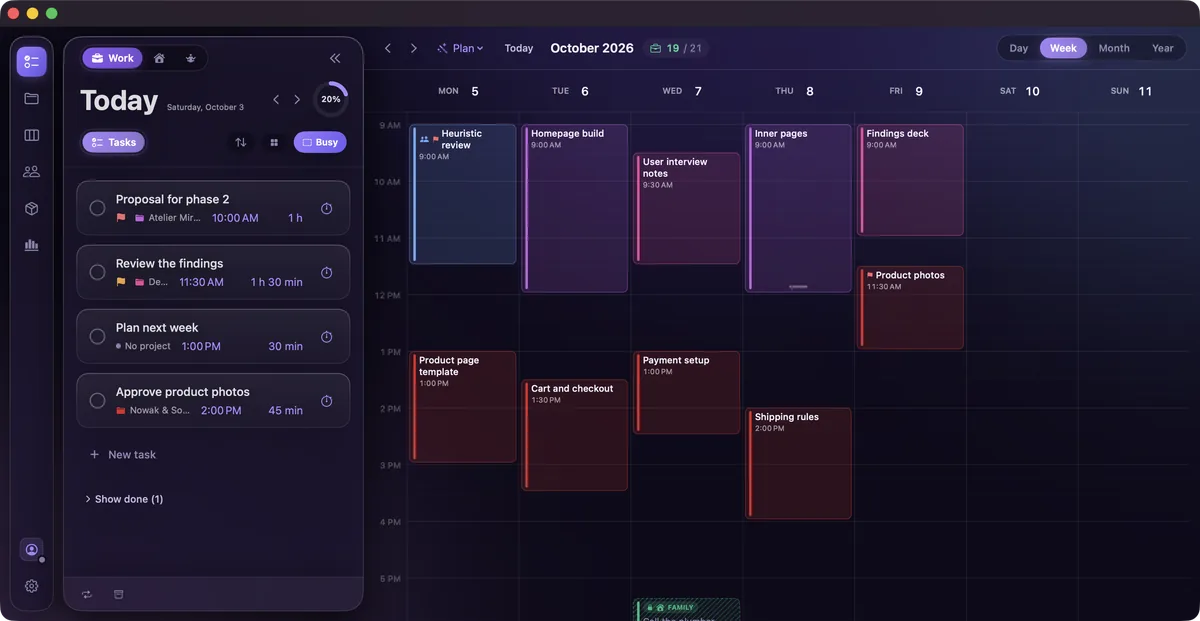
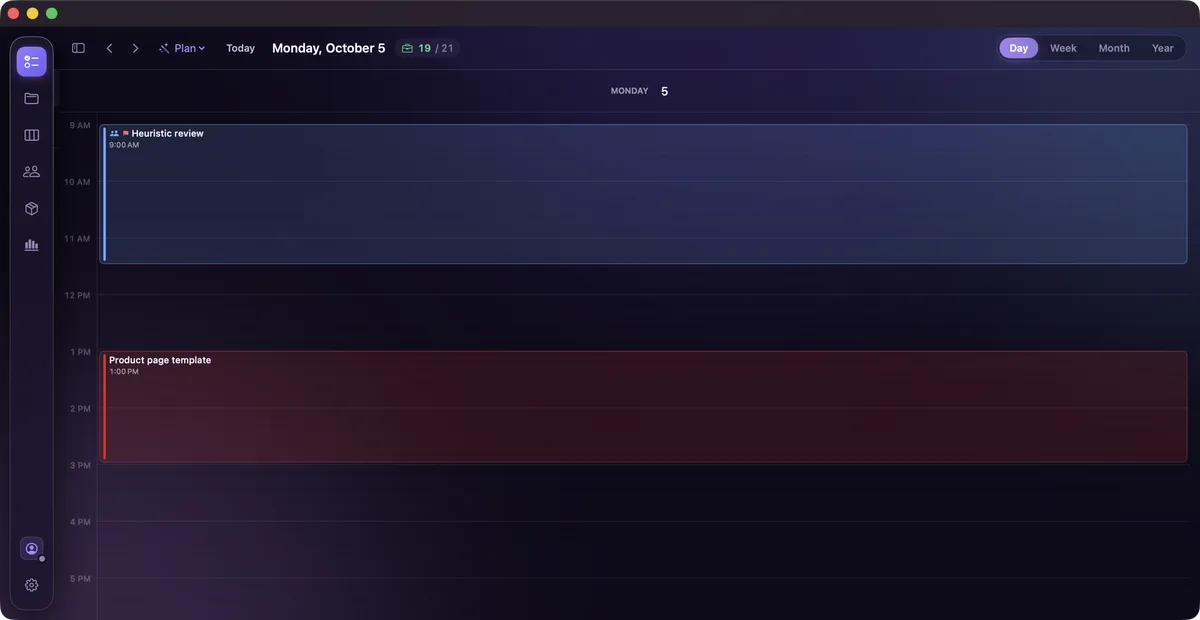
Myriad on a Mac: today’s tasks on the left, the week of 5 October with time blocks on the right

Real app, sample data.

Why one app

When you work alone, nobody joins your calendar to your timesheet. So you do it, every Friday.

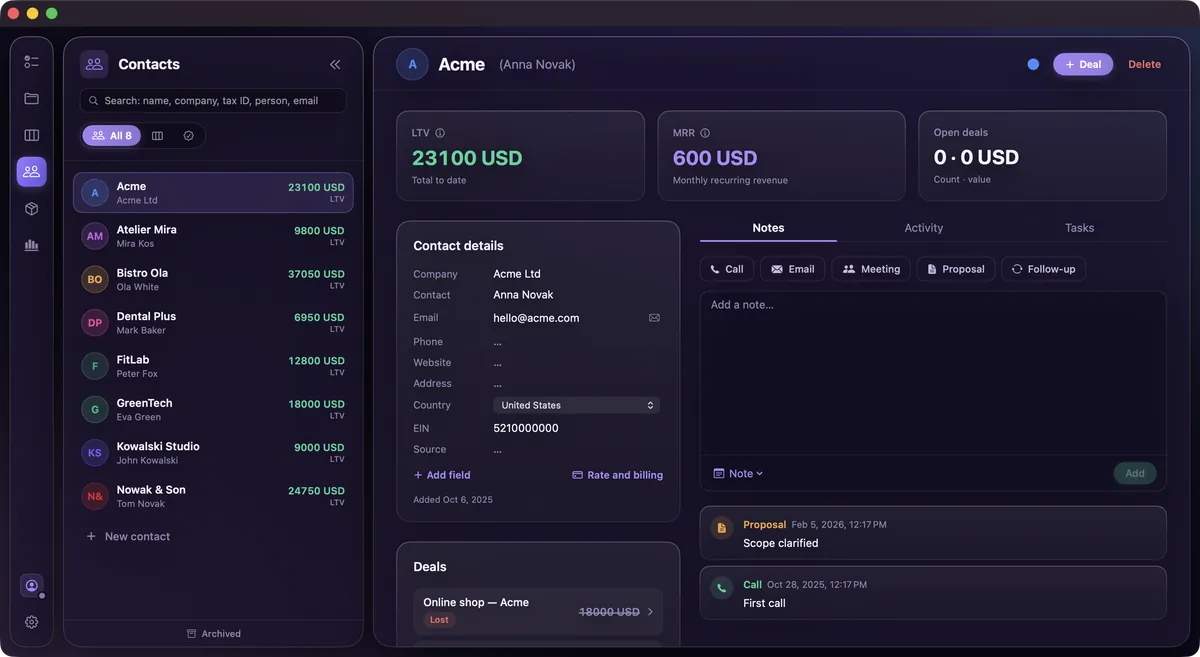
A client’s lifetime value and monthly recurring revenue
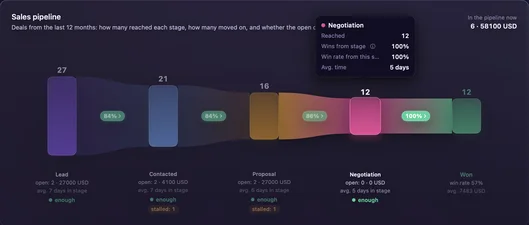
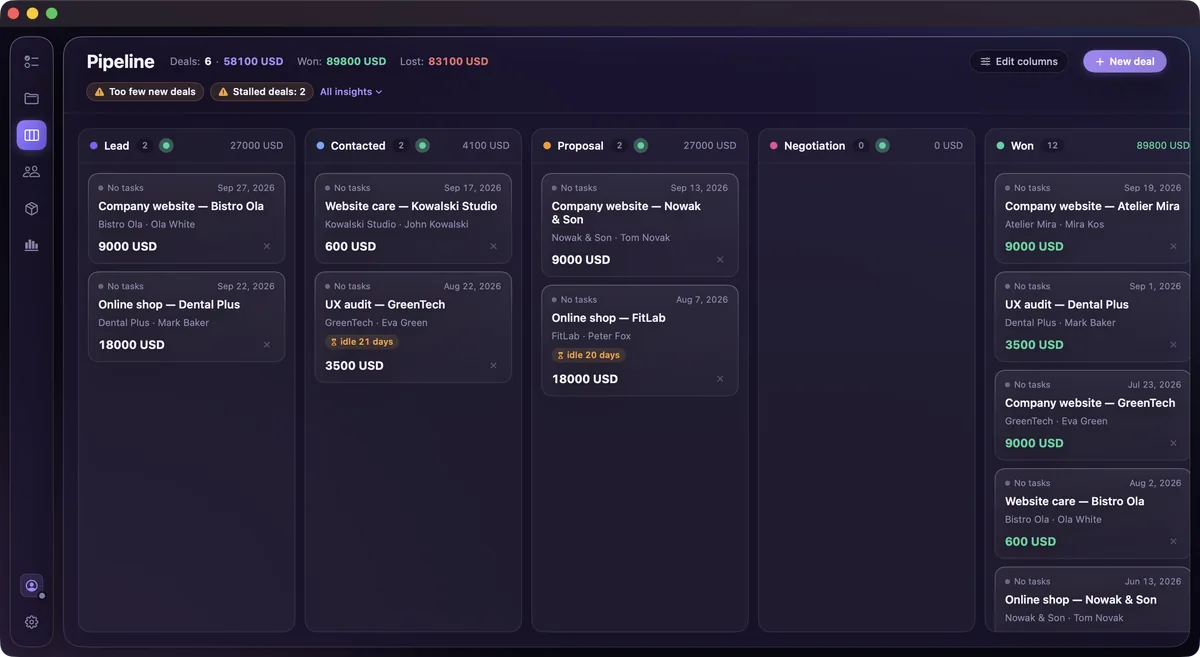
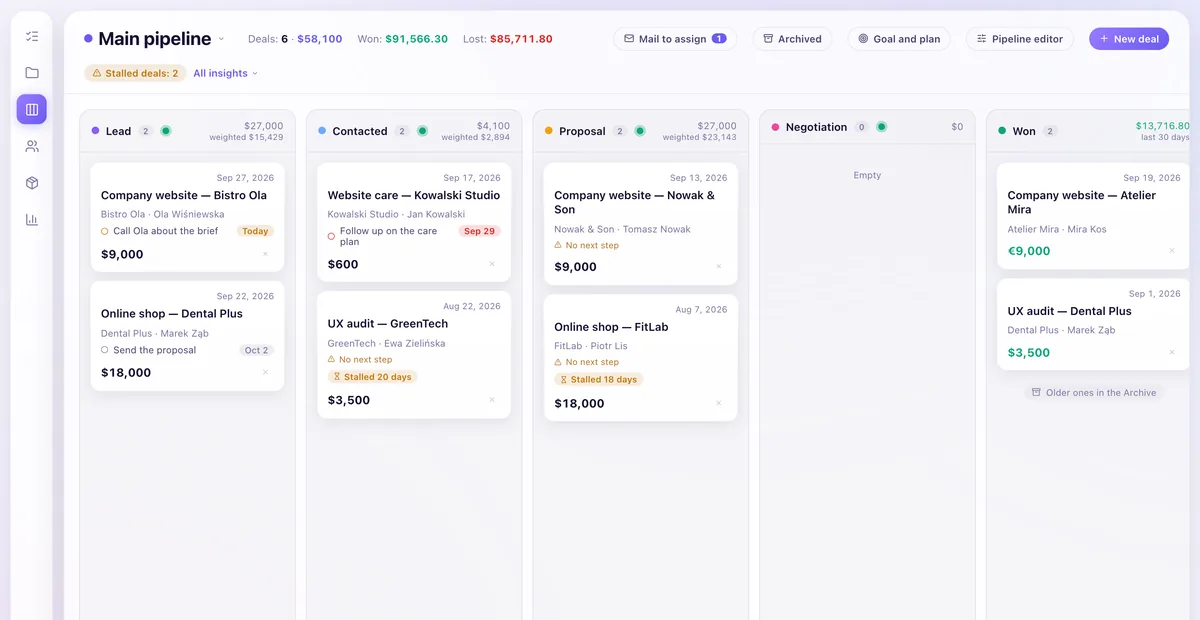
The sales funnel from lead to won
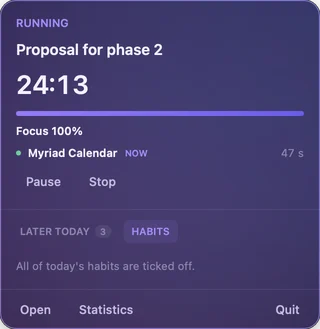
The timer in the menu bar with a focus score
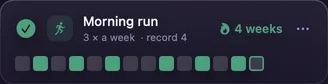
A habit with its streak
UsuallyHere

A to-do list that never asks whether today has room.

Every task takes a real hour on the grid, next to your meetings.

A deadline you check by gut feeling.

A forecast that counts working days, public holidays and your time off.

Hours in one app, clients in another, revenue in a spreadsheet.

One record: the hour you logged shows up in the project budget, the client profile and your effective rate.

Calendar

Every task gets an hour of its own.

Drag a task onto the grid and it becomes a block with a start and an end. Your meetings, your other calendars and the weather are drawn on the same grid, so you see the afternoon as it really is.

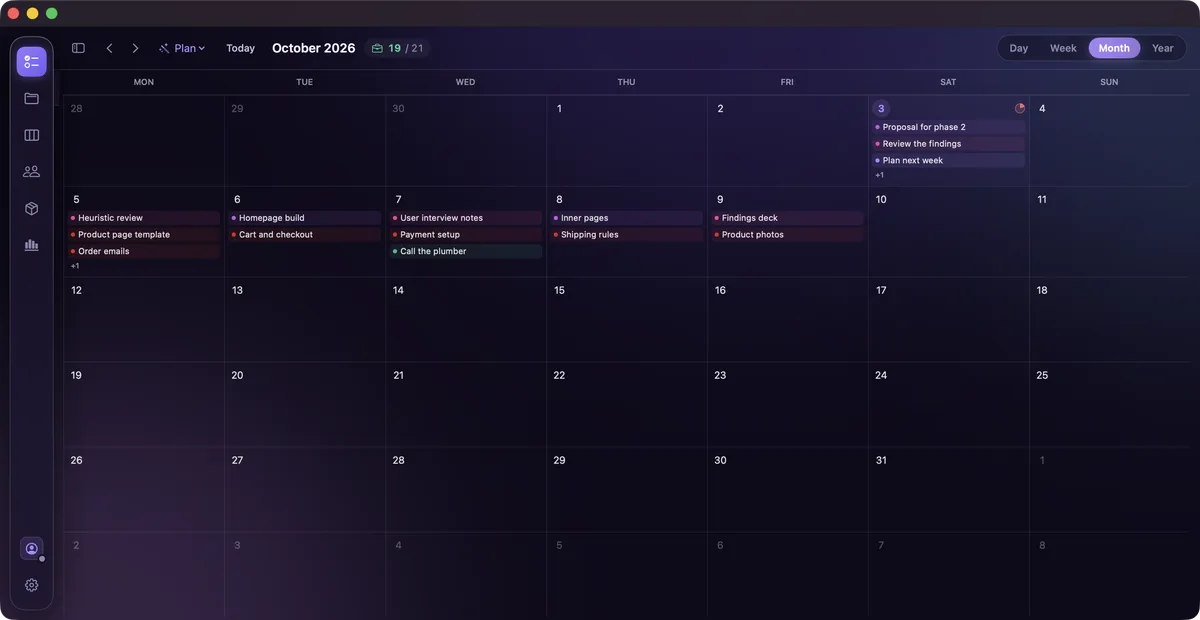
Month view of October with the blocks of each day

Day, week, month, year. From the whole year down to a quarter of an hour.

Work bands.

Mark Tuesday morning for deep work and Friday afternoon for admin. The week keeps that shape.

Days off look like days off.

Your workdays, your holidays, public holidays and occasions are on the grid before you plan anything.

Weather and daylight.

Rain at 15:00 and sunset at 16:12 are visible before you book the site visit.

Google and Microsoft, both ways.

Google and Microsoft calendars come in both ways. Writing back stays off until you pick the target calendar.

Work and home.

Work and home live in separate profiles. Time taken in the other one shows as busy, without the title.

The first free slot.

Ask for the first free slot long enough for the task. If there's no room in two weeks, it says so.

Plan

One click. A proposed day.

Plan gives each of today's loose tasks an hour that suits it. You see the proposal first, and nothing moves until you accept it.

  • The right task in the right slot. Deep work goes into your deep-work band first, not into the fifteen minutes before a call.
  • Nothing disappears. Whatever doesn't fit is listed by name instead of being pushed quietly to next month.
  • The week from your budgets. Plan my week reserves each project's hours from its budget. A client who buys 40 hours a month gets about 9 a week.
  • No crumbs. The planner won't cut a task into twenty-minute slivers across the day.
Monday before planning: two blocks, and loose tasks waiting for an hour

Plan my day on Monday: the proposal comes first, with what didn't fit named. Press Put in the calendar and the block is yours.

Quick add

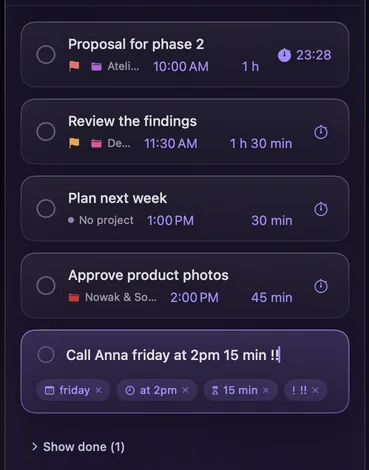
Type it the way you'd say it.

Write one line. The app reads the day, the hour, the length and the priority out of it, and shows every piece it took as a chip under the field.

  • Rules, not guesswork. A number becomes a time only next to "at", a colon, "min" or "h". "Top 10 ideas" stays in the title.
  • Every reading can be undone. Tap a chip and its words go back into the title.
  • Priority in one keystroke. ! is low, !! is medium, !!! is high.
  • Templates. Save the tasks you set up the same way every week and add them again without retyping.
Quick add: “Call Anna friday at 2pm 15 min !!” with chips for Friday, at 2pm, 15 min and priority

One line in, four chips out. Tap a chip and the words go back.

Timer and focus

Time you logged, not time you guessed.

Start a stopwatch or a Pomodoro on a task. Each session lands on the task and its project, so the budget and your effective rate update on their own.

  • Pomodoro that keeps to the clock. Phone asleep in your pocket? It wakes up in the right round, work or break.
  • A focus score from 0 to 100. It comes from your Mac activity: how much of the hour went to work and how often you switched apps.
  • A word next to the number. Deep focus, Not bad, Choppy or Scattered, so you don't have to decide whether 74 is good.
  • Distractions by category. Social media, video, news, shopping, games and messaging, plus any site or app you add yourself.
A task with a Pomodoro running, 24:56 left
On the task
The menu bar panel: the running task, the time left, the focus score, Pause and Stop
In the menu bar
Projects

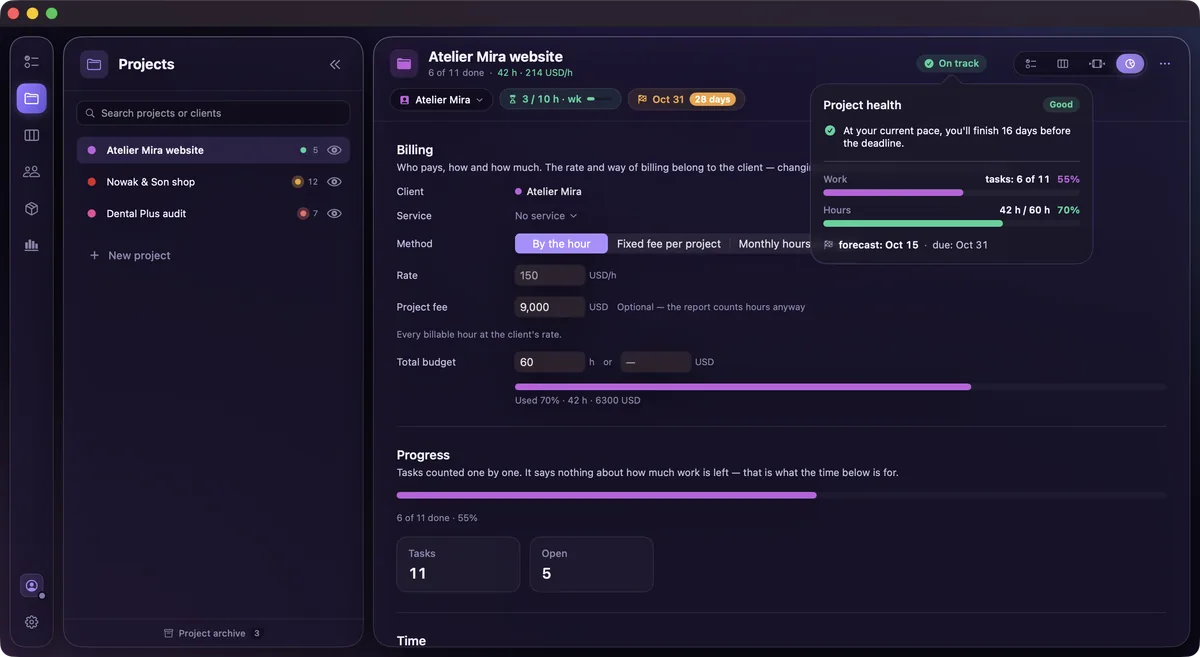
Will you make the deadline? It already knows.

Give a project a deadline and an hour budget. The app counts the working hours you have left, minus public holidays and your time off, and tells you whether the open work fits.

  • A forecast, not a countdown. On track, past halfway, at risk or late, with the number of hours you're short.
  • Budgets that match how clients buy. Hours per week, per month or for the whole project.
  • Kanban for the work, Gantt for the dates. Same tasks, two views.
  • Effective rate. What you earned, divided by every hour you logged, the unpaid ones included.
  • A report the client can read. A PDF with your logo, the hours and what got done.
Project health: at the current pace it finishes 16 days before the deadline, forecast 15 October, due 31 October
Project templates

Run the next website the way you ran the last one.

Save a project's columns and tasks as the template for a product. The next project for that product starts with the same board and the same tasks, so you don't rebuild your process every time.

  • Save as template. One click on a project that went well.
  • Start from a template. Pick one when you create a project, or load it into a project you already have: replace its columns, or add only what's missing.
  • Categories for projects. Group them into Work, Family or any category you add, sort them, and move a project with all its tasks in one step. Categories are the same profiles you use in the calendar.
Projects grouped by category: Family, Me and Work. A new project, GreenTech website, is being started from the Company website template, with 3 columns and 10 tasks

Projects in their categories, and a new one started from the Company website template.

Pipelines

One pipeline for new work. Another for renewals.

When you sell two things in two different ways, give each one its own pipeline. Start from one of 12 templates or from an empty board. Every pipeline keeps its own stages, win chances and numbers.

  • 12 templates to start from. Service sales, agency new business, freelance gigs, consulting, renewals, partnerships and more, with the stages and win percentages already filled in.
  • Numbers for each pipeline. New deals, open value, win rate and sales cycle side by side. Each pipeline is judged against its own history, not against the others.
  • One goal for the company. Every pipeline counts toward the same monthly target, so you see whether the month as a whole is ahead of plan.
  • A warning on every deal without a next step. A card with nothing planned says so on the board, before the deal goes quiet.
calendar.myriadself.com
The main pipeline: Lead, Contacted, Proposal, Negotiation and Won. Cards show their next step, such as Call Ola about the brief today, or a warning that there is no next step

Two pipelines, one goal. The Renewals pipeline came from a template in two clicks.

Tasks and calls

Every deal knows what happens next.

Add a task straight from a deal or a contact. It lands in your day like any other task, and the card shows it as the next step until you tick it off.

  • The usual steps in one click. Call, send an email, send an offer, a meeting or a follow-up, for today, tomorrow, in 3 days or in a week.
  • Call from the card. Press Call on your iPhone and it measures how long you talked. When you come back, a short card asks how it went. On the Mac the call goes through your iPhone, and the time is an estimate you can correct.
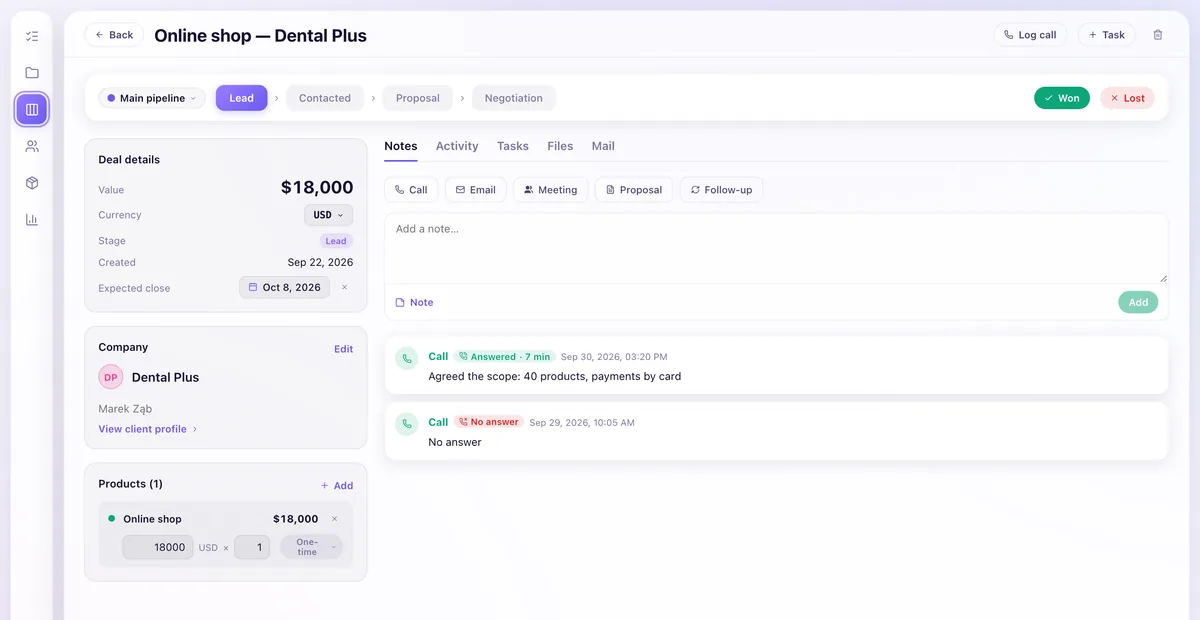
  • Every call in the history. Answered, no answer, voicemail or call back, in green, red or orange, with its length and your note.
  • A missed call becomes a task. Pick No answer and a Call back task is filled in for later that day, or for 9:00 the next morning.
calendar.myriadself.com
A deal, Online shop for Dental Plus, with two calls in its notes: answered, 7 minutes, scope agreed; and no answer the day before

The call is logged on the deal it was about. In the browser you log calls by hand.

Email at your deals

The emails about a deal, next to the deal.

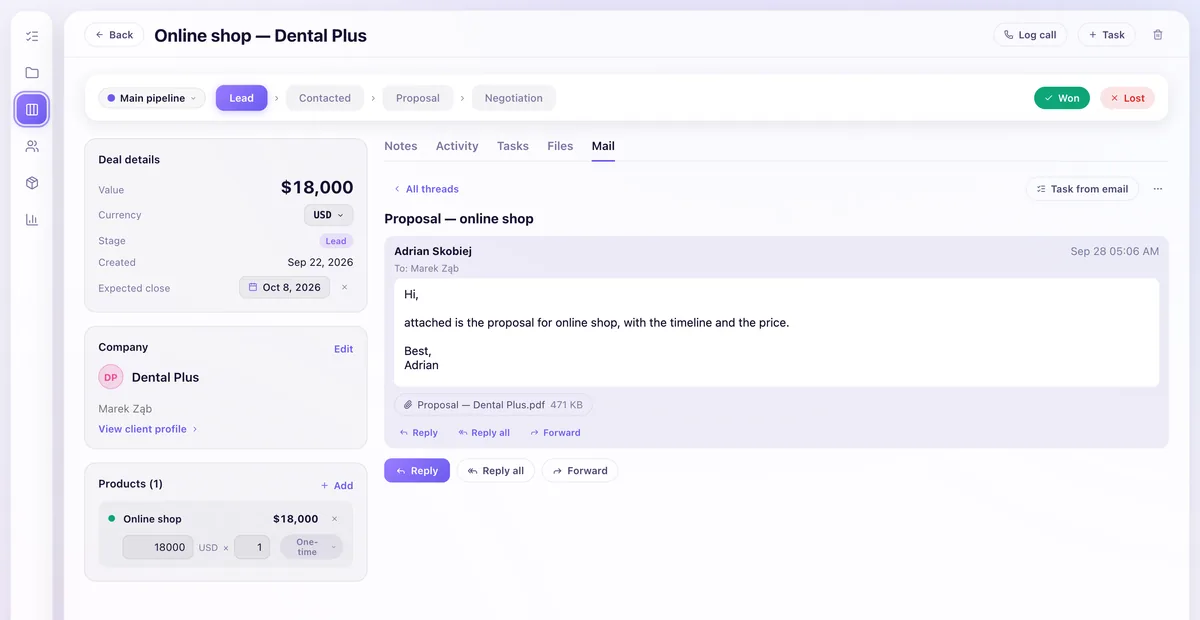
Connect your own mailbox. Myriad keeps only the emails with people who have a deal in your pipeline. You read and answer them on the deal, and the reply goes out from your own address.

  • Only the mail that matters for sales. Newsletters, private mail and everyone else stay in your inbox. Myriad doesn't fetch or keep them.
  • Your mailbox, your address. Outlook and Microsoft 365, Gmail with an app password, or any other IMAP mailbox. An app password is stored encrypted, and you can revoke it with your provider at any time.
  • A BCC address for the rest. Forward an email to your Myriad address, or put it in BCC, and it lands at the contact's deal.
  • No open tracking. No mass campaigns either. It's for talking to clients, one thread at a time.
calendar.myriadself.com
An email thread on the deal: the proposal for the online shop sent to Marek with the PDF attached, with Reply, Reply all and Forward

The thread sits on the deal it belongs to. Reply, and it goes from your own mailbox.

Files

Every file you uploaded, and where it belongs.

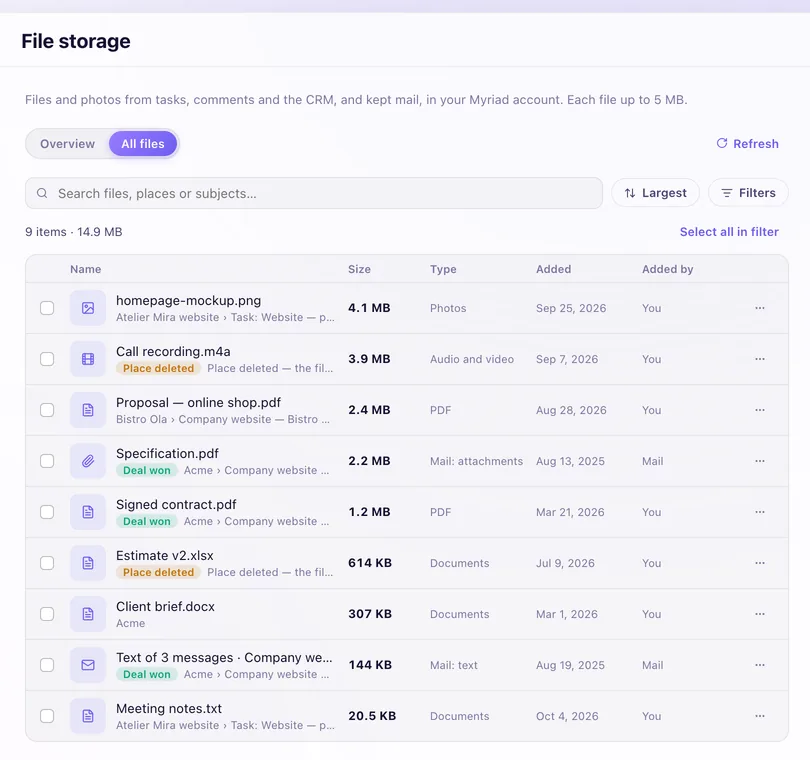
Attach files to tasks, comments, contacts and deals. Settings list all of them in one place: what it is, what it's attached to, how big it is and who added it.

  • 10 GB for files and mail. One shared space on your subscription, your team included. The 7-day trial has 500 MB.
  • Make room in a minute. Files left behind by deleted tasks, files in the archive and old mail attachments are grouped with their size, so you know what to clear first.
  • An archive for the CRM. The board keeps deals closed in the last 30 days. Older deals and contacts you no longer work with wait in the archive, with their files.
All files: a mockup, a call recording, a proposal, a signed contract and more, each with where it is attached, its size, type, date and who added it
As you grow

One app from your first client to your first hire.

Most freelancers grow the same way: first alone, then with a contractor or two, then with someone who works with you every week. The app stays the same at each step and adds what that step needs. You pay only for the people you add.

$9.99 a month or $79.99 a year

Just you

You sell your hours, so your calendar has to know what they're worth.

  • Every task gets a real hour on the grid, next to your meetings.
  • Each project has an hour budget and a forecast that says whether the deadline holds.
  • Clients, deals and revenue sit next to the time you logged.
  • Your effective rate: what you earned divided by every hour you worked, unpaid ones included.

You keep your own plan at every step. Each person you add is $8 a month or $80 a year, and gets the full app for as long as they're on your team.

Contractors

Know what you owe before they send the invoice.

Add a contractor to the project they work on and set once how you pay them. From then on the app keeps a running balance for each person: what they've earned, what you've paid and what's still open.

  • They see only what you share. A contractor gets the projects you give them access to. Your other projects, and anything that isn't in a shared project, stay off their screen.
  • Paid the way you agreed. By the hour, with their rate times the time on their own timer. Or a monthly fee, a set amount per task, an amount per milestone, or an entry you type in yourself for a bonus or an expense.
  • A balance that colours itself. What you owe minus what you paid, per person. An open line is orange, and turns red once it's more than 30 days past the end of its period.
  • Mark as paid, then export. One click closes a line. A CSV export goes to whoever keeps your books, because the app tracks payouts and doesn't issue invoices.
  • Real profit on every project. Payouts count as project cost the moment they're earned, paid or not. Numbers subtract them from revenue and show profit and margin.
  • The amount on a task is yours. You can put a payout amount on a task or a milestone. The contractor sees the task. Only admins see the amount.
Sample data
Payouts · October
MK
Marek · ContractorBy the hour · $45/h
Set once. Change it any time.
Owed to Marek$0
Owed

Marek's timer adds up to 18 h 30 min, and at $45/h the balance reads $832.50. Press Mark as paid and the balance drops to zero. Profit stays where it was, because the cost was counted when he earned it.

Employees

Assign a task. See if it fits their week.

Once someone works with you every week, your calendar stops being the only one that matters. Give a task to a person and the forecast runs on their work week, the public holidays and their time off.

  • Assign and get an answer. Pick a person and the deadline forecast reads On track, At risk or Late, with the number of hours they're short.
  • Workload for the whole team. Each person's planned hours next to the hours they have. You see who has room before you hand out the next job.
  • They set their own week. Each person enters the hours they work on each day. A four-hour Friday stays a four-hour Friday in every forecast.
  • What's private stays private. Habits, private profiles and settings never reach the team. They see the shared projects, and you never see their personal ones.
  • Monitoring only on a project you choose. Off by default. Switch it on for one of your projects and the person's Mac records their work only while their timer runs on a task from that project. They accept the rules once and see a Monitored badge next to the timer every time.
Who takes it?Sample data
Homepage buildAtelier Mira · 14 h left · due Friday
Workload · this week
PlannedAvailable
● 42:10 · Homepage buildOla's timer

Give the homepage to Ola and the forecast reads On track. Give her Thursday off and it turns to At risk: short by 2 h.

What monitoring records, and what it never does

This is the whole list, so nobody on your team has to guess.

While the timer runs, on a Mac
  • Which apps and website domains were in use, and for how long
  • A focus score from 0 to 100
  • App switches per hour
  • The longest focused stretch
Never
  • Anything before the timer starts or after it stops, or while it's paused
  • Work on other projects
  • The list of apps installed on the Mac
  • Screenshots, keystrokes, or what's on the screen
  • App data from the iPhone, which reports time only

The admin and the person see the same report. If someone declines the rules, the timer on that project won't start. Everything else in their app works as before, and they can withdraw their consent later in the project's team rules.

Habits and repeats

For the things that come back.

Repeats as specific as your contracts, and habits with a history you can actually look at.

  • Repeats that match real life. The last Friday of the month, the second Tuesday, every 10 days from when you last did it.
  • Habits with streaks. Each one keeps its full history, so one missed day doesn't erase the month.
  • Unfinished moves to tomorrow. What you didn't get to rolls forward by itself instead of turning red in yesterday.
Habits in the Me profile: Morning run 3 times a week, Read 20 pages, Spanish lesson, No phone after 10 pm, each with streak and history
Devices and sync

Plan on the Mac. Check it on your wrist.

The Mac is where you plan. The iPhone has the day and its widgets, and the Apple Watch shows what's next and lets you tick it off. All three show the same day.

Myriad on a Mac

Mac. Where you plan: the week, the projects, the clients and the numbers.

Apple WatchiPhoneMacWeb

Tick a task on the Watch. It's crossed out on the iPhone, then on the Mac.

Your own iCloud.

Sync works through your iCloud with no extra sign-in.

Or a Myriad account.

Sign in with Apple, with Google or with a link sent to your email. No password to remember.

Private by design.

Each account can read only its own records. No ads. Google and Microsoft calendars come in through the accounts already on your Mac and iPhone, so the app never holds their passwords.

In your language.

English, German, Spanish, French, Italian, Japanese, Korean, Brazilian Portuguese, Traditional Chinese, Russian and Polish, in the web app too.

Wherever you work

No signal, another currency, another tool. It still adds up.

A train without wifi, a client who pays in euros, a lead form on your website. The app is built for the days that don't go to plan.

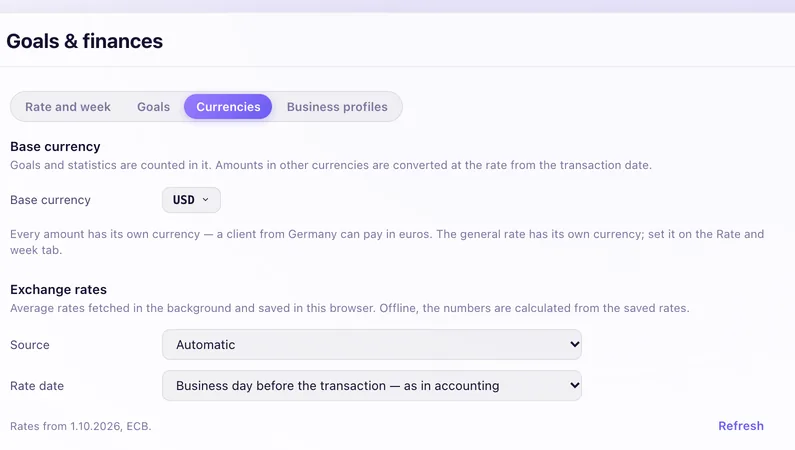
Currencies: the base currency is USD, and amounts in other currencies are converted at the rate from the business day before the transaction, from the ECB

Every amount in its own currency.

Bill one client in euros and another in dollars. Your statistics convert everything to your main currency at the rate from the business day before each payment, the way accountants count it.

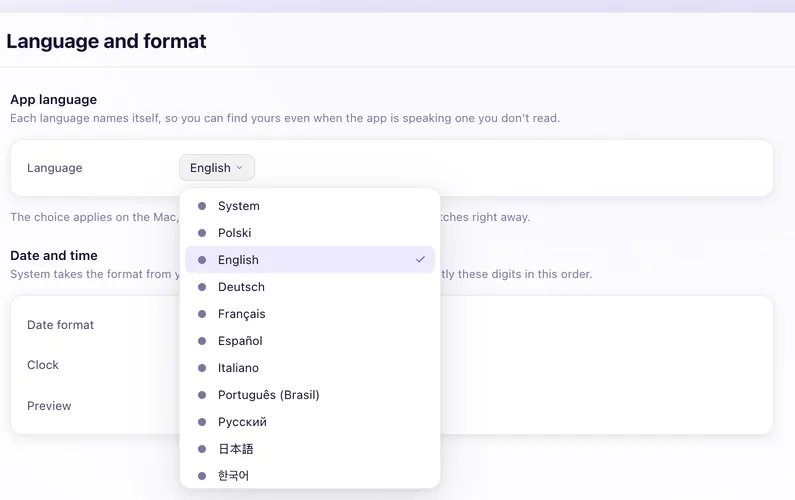
Language and format: the language menu with Polski, English, Deutsch, Français, Español, Italiano, Português (Brasil), Русский, 日本語 and 한국어

The web app in 11 languages.

The same English, German, Spanish, French, Italian, Japanese, Korean, Brazilian Portuguese, Traditional Chinese, Russian and Polish as on the Mac and iPhone. Each language is listed in its own name.

Works without internet.

Plan, tick off and time your work on a plane. Changes wait on the device and go out by themselves when you're back online. The web app opens without a connection too, and you can install it like any other app.

Connected to the tools you already use.

With a Myriad account, leads from your website forms, Zapier, Make, Pabbly Connect and n8n go straight into the CRM through webhooks, and Myriad tells your other tools when a deal is won. Building something of your own? Read the API docs. Ready-made Myriad apps for Zapier, Make and Pabbly Connect are coming.

Pricing

Seven days of everything. Then monthly or yearly.

The trial opens every feature for seven days. After that you choose a monthly or a yearly subscription.

Monthly $9.99/ month

Pick the one that fits how you budget.

Subscribe monthly
Everything in the app
  • Calendar with time blocks, from a year down to a quarter hour
  • Plan my day and Plan my week
  • Quick add in one sentence, templates and repeats
  • Stopwatch and Pomodoro, with a focus score on your Mac
  • Projects with hour budgets, Kanban and Gantt, templates and categories
  • Deadline forecast and a client report (PDF) with your logo
  • Several pipelines from 12 templates, with one company goal
  • Tasks and logged calls on every deal
  • Email at your deals, sent from your own mailbox
  • Clients with LTV and MRR
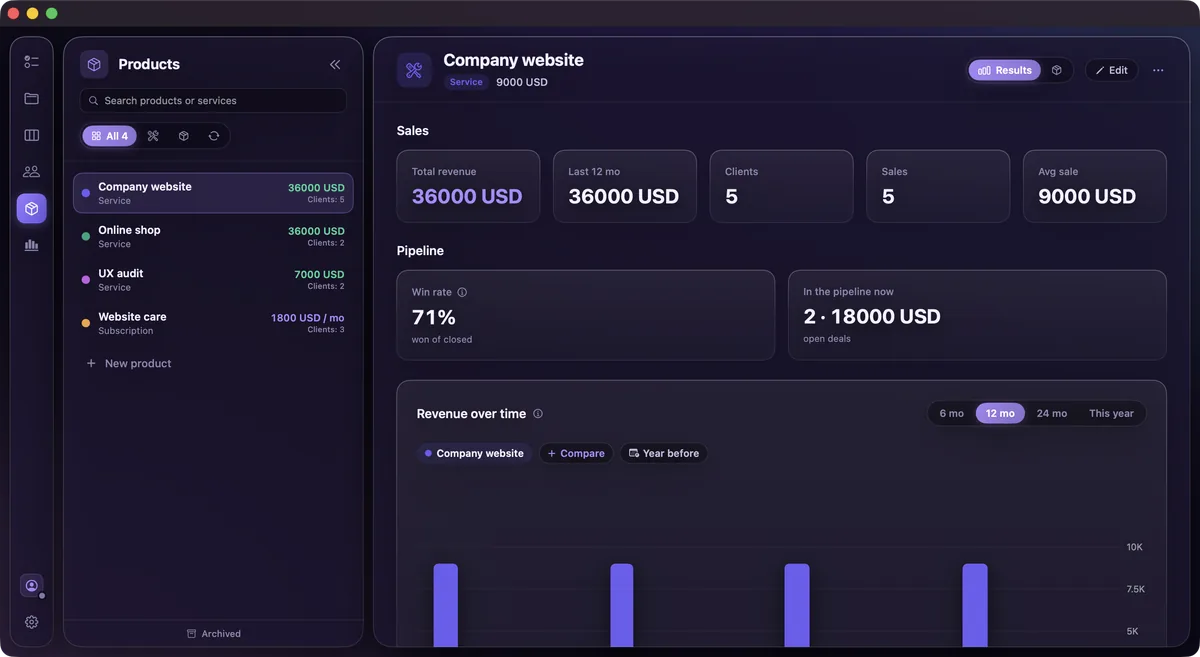
  • Products and services, compared year on year
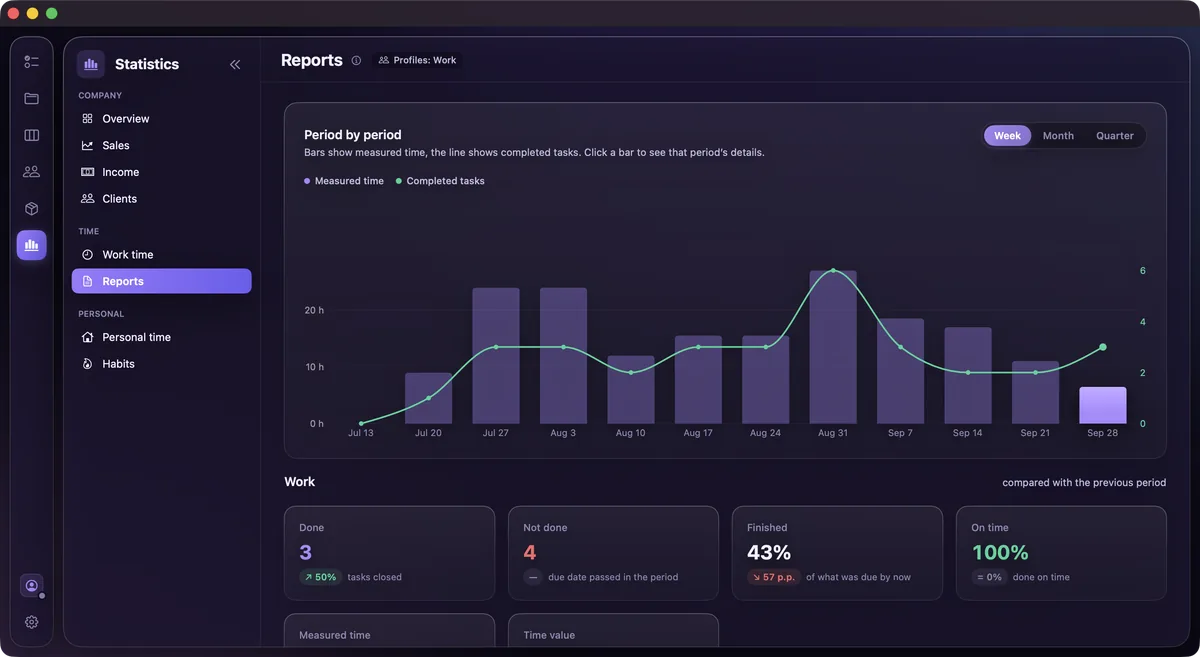
  • Numbers coloured good or bad, habits with streaks
  • 10 GB for files and mail (500 MB during the trial)
  • Any currency, converted in your numbers
  • Mac, iPhone, Apple Watch and the web, which also works offline
  • Webhooks for Zapier, Make, Pabbly Connect and n8n, and an API
  • Sync through iCloud or a Myriad account
  • 7 days free, no card needed
  • Cancel anytime
Teams +$8/ person / month

or $80 / person / year. On top of your own plan. You don't take a seat; each person you add does.

See how teams work
What a team gets
  • Employees, contractors or family, each with their own Myriad account
  • One shared profile for the team's projects and tasks
  • Assign a task and see if it fits that person's week
  • Workload per person: planned hours against available hours
  • Contractor payouts by the hour, monthly, per task or per milestone, with Mark as paid and CSV export
  • Payouts count as project cost, so Numbers show profit and margin
  • Contractors see only the projects you share with them
  • Optional monitoring on a project you choose: Mac only, only while the person's timer runs, after they accept
  • Each person gets the full app while on your team. Their habits and private profiles stay private.
  • Files and mail share your 10 GB space

Start on your own plan and add people when you need them. You buy seats in the Mac app downloaded from this site.

Prices in USD. Local price and VAT shown at checkout.

Not sure yet? Try every feature free for 7 days. No limited mode, no ads, no card. On iPhone and Apple Watch the subscription runs through the App Store. It is not accounting software: invoices stay in the tool you already use for them.

Already have an account? Sign in · Already subscribed? Manage subscription · Ask a question

FAQ

Frequently asked questions

For the Mac, start the 7-day free trial on this page. For iPhone and Apple Watch, get it from the App Store. All three show the same day.

Seven days free with every feature, then $9.99 a month or $79.99 a year. Each person you add to a team is $8 a month or $80 a year. Prices are in USD; your local price and VAT are shown at checkout.

No. Myriad isn't accounting software. It tracks your time, projects, clients and revenue, and the client report is a PDF of hours and work done, not an invoice.

Yes, through the accounts you've already added on your Mac and iPhone. Events come in with their meeting links. Your blocks go out only after you choose which calendar they should go to.

No. Sync through your own iCloud works without one. A Myriad account is optional: you sign in with Apple, Google or an email link.

In your iCloud, or in your Myriad account if you use one. Each account can read only its own records and the team projects it has access to. There are no ads.

No. Plan places loose tasks into free time and shows you the result first. Nothing changes on your calendar until you accept it.

Yes, when you need one. It starts as a tool for one person running their own work. When the work grows, add employees, contractors or family to a shared team profile for $8 a person a month or $80 a year, on top of your own plan.

Your own plan stays as it is: $9.99 a month or $79.99 a year. Each person you add is $8 a month or $80 a year, and you don't take a seat yourself. An invitation holds a seat for 14 days, so a person you invite can always accept. While they're on your team, the seat gives them the full app.

No. A contractor sees only the projects you share with them, and you can change that list later. Your other projects, and anything that doesn't belong to a shared project, stay hidden. They also don't see the payouts panel or the amounts you put on tasks.

Nothing, unless you switch it on for a project. When it's on, a person's Mac records only while their timer runs on a task from that project: which apps and website domains were in front and for how long, a focus score, app switches and the longest focused stretch. It skips everything outside the timer, pauses included, and never takes screenshots, keystrokes or screen content. The iPhone reports time only. The admin and the person see the same report. Before the first timer, the person reads the rules and accepts or declines them; if they decline, the timer on that project doesn't start. The reason is simple: a timer that quietly doesn't record misleads the admin, and one that records without the person knowing misleads them.

No. Myriad keeps only the emails with people who have a deal in your pipeline, open or closed in the last 30 days. The rest of your mailbox stays where it is, and nothing tracks whether your emails were opened.

Yes. On the Mac, the iPhone and in the browser you can keep planning, ticking off and timing your work. Changes are saved on the device and sent by themselves when you are back online.

Yes, with a Myriad account. Zapier, Make, Pabbly Connect and n8n connect through webhooks, so leads from your forms reach the CRM and your other tools hear when a deal is won. The API is documented at api.myriadself.com/docs.

Mac · iPhone · Apple Watch

Your hours, your clients and your deadline in one place.

Try every feature for seven days on Mac, iPhone and Apple Watch. If something would stop you from switching, tell us, while it's still easy to change.

Already have an account? Sign in

Ask for a feature  ·  All apps